

By Electrical and Instrumentation / Control Lead Slawek “Swav” Wolski
In many industrial facilities—like water treatment plants, pumping stations, or manufacturing lines—operators rely on computer screens to understand what’s happening in real time. These systems are often called SCADA systems (Supervisory Control and Data Acquisition).
At the heart of these systems are the screens people interact with every day. These are called HMIs, or Human-Machine Interfaces. Simply put, an HMI is the window into the processes taking place in the facility—it’s how operators see flows, levels, pressures, alarms, and equipment status all in one place.
When designed well, an HMI helps people make quick, confident decisions.
When designed poorly, it does the opposite. Keep reading to learn how better SCADA design can transform operations—and why it matters.
When More Data Becomes a Problem
As data continues to grow exponentially, SCADA systems are becoming increasingly cluttered. What was once intended to empower operators is now often overwhelming them. Operations staff are bombarded with alarms, values, and indicators—yet are given little guidance on where to focus.
In critical or emergency situations, this overload becomes more than an inconvenience—it becomes a liability. Instead of enabling fast, confident decision-making, poorly designed screens can slow operators down when every second matters.
From Data Dumps to Meaningful Design
Organizations like the International Society of Automation (ISA) have introduced guidelines (such as ISA-101 published in 2015) that promote clearer, more focused screen design. These guidelines encourage designers to focus on situational awareness and help prioritize what matters most. Additionally, it provides a guide to designing graphical interfaces that are more informative.
But it’s not just about a standard published by ISA over a decade ago. If it was, screen design would have drastically changed. It’s about recognizing a deeper opportunity: treating screen design as a craft.
Engineers as Visual Communicators
Engineers and SCADA developers are rethinking our roles.
We are not just builders of control systems—we are visual communicators. Every screen we design tells a story. The question is: does it tell the right one? This question is often missed or not asked during screen design. As our world of automation evolves with new technologies, this is becoming a more important question.
Combining those ISA-101 principles with strong graphic design thinking allows us to move beyond simply displaying data.
This shift requires intention to:
- Prioritize what matters most
- Guide the operator’s eye
- Reduce noise to highlight critical conditions, and
- Design for cognitive understanding.
Designing for Clarity Under Pressure
A well-designed HMI screen should do more than look clean—it should perform under pressure.
Operators shouldn’t have to hunt for information or interpret clutter during an upset condition. The right design makes the important things obvious at a glance.
There’s an old saying: a picture is worth a thousand words.
In the world of SCADA, a well-designed HMI screen might be worth a thousand alarms.
The Three Pillars of Good Screen Design
To make screens that people can quickly understand, three simple design ideas matter most:
- Negative Space
Negative space is the empty or open area around and between elements on a screen. It may seem like “unused space,” but it’s what allows us to understand what we’re looking at. Without space, everything blends together. With space, important information stands out. - Hierarchy
Hierarchy is about showing what is most important. It’s how elements are arranged so the eye naturally goes to the right place first. On a good HMI, the most critical information—like alarms or abnormal conditions—should always be the easiest to see. - Contrast
Contrast is the difference between elements placed close together—such as light vs. dark, large vs. small, or dull vs. bright. It helps draw attention. On a screen, contrast is what makes something stand out immediately when it changes or goes wrong.
These ideas are simple—but they are often missing in real systems.
A Changing Industry: Designing Together, Not at the End
The role of SCADA and HMI development is evolving—and so is how engineers design these systems.
In the past, HMI screens were often built by programmers or engineers late in a project. They were reviewed during what’s known as Factory Acceptance Testing (FAT), when everything was already in place. At that stage, there is very little opportunity to improve the design—only to fix what doesn’t work.
But effective HMI design requires more than just programming. It requires understanding how the process operates, how operators think, and how information should be presented—especially under pressure.
This is where a new kind of role is emerging: SCADA design specialists.
These individuals:
- Sit between engineering and operations
- Understand how the process works
- Understand what operators need to see
- And know how to design screens that communicate clearly
Engineers define how the system should work. SCADA designers bring that to life in a way that operators can quickly understand and act on.
But for this role to be effective, design cannot happen at the end—it must be part of the process from the beginning. HMI development should follow the same structured approach used in engineering:
- 30% Design – Early concepts, layouts, and conversations about how the system will be operated
- 60% Design – Refining screens with input from operations, maintenance, and engineering
- 100% Design – Finalizing screens with confidence they will perform in real-world conditions
This approach brings the right people to the table at the right time:
- Operators who understand day-to-day operations
- Maintenance staff who know where issues arise
- Engineers who understand the system design
- SCADA designers who turn all of that into clear, usable screens
Design becomes a conversation—not a last-minute review. And that shift—from building screens at the end to designing them together from the start—is what will ultimately improve how systems are operated.
Why This Matters to Everyone
This isn’t just a SCADA issue—it affects everyone involved.
- Operators get clearer, easier-to-use screens.
- Maintenance teams can troubleshoot faster.
- Engineers deliver systems that are easier to use.
- Organizations improve safety and reliability.
Better screens lead to better decisions.
The Opportunity Ahead
The tools and standards are already available. What’s missing is a mindset shift.
If we start treating HMI design not as an afterthought, but as a discipline—one that blends engineering with design—we can dramatically improve how operators interact with their systems. This step is critical to industrial operations as technology improves.
It’s time to bring the art back to engineering. See one example below:
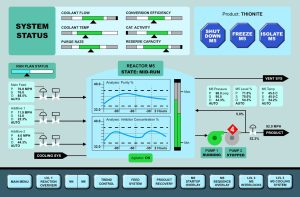
You may be considering how to improve your HMI design. If you have questions on how to get started, contact me. I’ll be at the OWWA NextWave 2026 Conference this week presenting on this topic. Check out my presentation on Tuesday, May 5, 2026, 11:30 AM – 12:00 PM and ask any questions.


